Oliver Hardy
38 titles
Filmography
38 results

The Music Box
(1932)In remaking the notoriously lost film Hats Off, the boys deliver a crated player piano to the home atop a steep hill. This film won the Academy Award® as “Best Short Subject, ” the first short ever to be so honored. Critics then and now have exhausted all superlatives in celebrating The Music Box. Laurel himself conferred his personal endorsement as the best picture the partnership produced. The Library of Congress enshrined the short on its National Film Registry deeming it to be “culturally, historically, or aesthetically significant. ” The most famous, most askedabout shooting location in all Hal Roach comedies is the terraced staircase shown here. Official city street signs and an etched black marble plaque mark the site today in the Silver Lake district of Los Angeles. Directed by James Parrott. With Billy Gilbert and Charlie Hall.

The Best of Laurel and Hardy
(1968)A collection of the duo’s best colorized shorts including Night Owls and Alley Cats, The $125 Misunderstanding, A Dollar a Head, and many more.
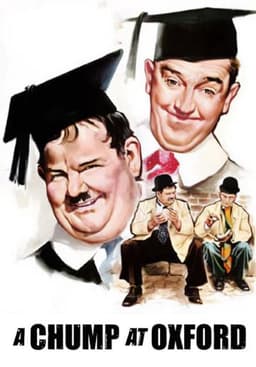
A Chump at Oxford
(1940)A reward for catching a bank robber sends street sweepers Laurel and Hardy to the Ivy League where Stan is mistaken for a missing lord with amnesia.
Saps at Sea
(1940)In this twist on SOULS AT SEA (with a nod to Chaplin’s MODERN TIMES), Ollie goes berserk at the horn factory. When the doctor recommends an ocean voyage as an antidote to calm his nerves, the fellows rent a ship that slips her moorings and drifts miles from shore … with an escaped murderer on board. This farewell Laurel & Hardy film at the Hal Roach Studios was nostalgic, almost on par with A CHUMP AT OXFORD. Critics loved the lively, old-fashioned slapstick. Thereafter, Roach allowed his deal with Laurel & Hardy to lapse, and while both the partnership and studio flirted with the idea of reuniting to produce more movies, and eventually TV programs, strokes suffered by the two comedy giants in the mid-1950s finally made any such plans impossible. Directed by Mr. Roach’s protégé, Gordon Douglas. With James Finlayson and Rychard Cramer. Plus former Mack Sennett silent star Ben Turpin, and Harry Bernard, close friend of Charley Chase; all three of whom died shortly after the picture was issued to movie theaters.

Tit for Tat
(1935)
County Hospital
(1932)With nothing else to do, Stan pays banged-up Ollie a visit in the hospital, bringing a gift of hardboiled eggs and nuts. The wild ride at the end was intended to top the one from HOG WILD, but economic conditions dictated otherwise. After a screening at his home in 1986, Hal Roach explained, “We tried to make a gag out of the rear projection by showing we knew the thing looked phony. ” This is the last of five shorts re-released by M-G-M in 1937, when it was fitted with a lively new musical score by Roy Shield. The production credits cards and the opening gag titles (deemed a relic of the silent era) were deleted, then the main title was modernized. Only this reissue adaptation remains today. Directed by James Parrott. With Billy Gilbert.

Brats
(1930)
Pardon Us
(1931)Developed as a two-reeler spoofing prison pictures, the project grew into Laurel & Hardy’s first feature film at Roach. For years, their popular shorts were billed above the feature attraction on theatre marquees, so, at last, they appeared in a full-length movie themselves. Imaginative individual set pieces are among the fellows’ funniest and most endearing, including a prison-school sequence meant to echo the shorts being made by Our Gang at the time. Listen carefully early in the picture when someone in the crew cannot help himself and laughs off-scene! This is an extended version, restored to reflect what the motion picture looked like during its final preview stage. Directed by James Parrott, who along with Hal Roach makes a gag appearance as a prisoner. With Wilfred Lucas, James Finlayson, June Marlowe (OUR GANG’S “Miss Crabtree”) and Walter Long as the “The Tiger. ”
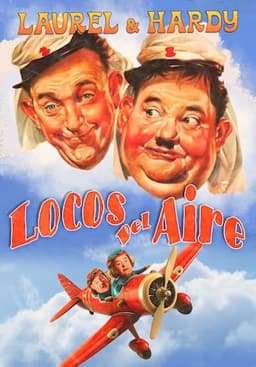
The Flying Deuces
(1939)To get over a recent heartbreak, Olly joins the French Foreign Legion with his pal Stan and the two manage to get sentenced to a firing squad.

The Laurel-Hardy Murder Case
(1930)In order to claim an inheritance, the boys present themselves at a creaky, bat-filled mansion on a stormy night. The blockbuster of all Laurel & Hardy shorts was, surprisingly, this playedstraight spoof of old dark-house horror chillers. It grossed almost four times as much as Another Fine Mess, clearly a superior picture. The only explanation must be the many special, multiple, phonetic language versions that were made, and, most especially, the clever title, which foretold and teased the melding of two different popular genres, mystery and comedy. Directed by James Parrott. With Fred Kelsey and Del Henderson.

Chickens Come Home
(1931)In a literal reworking of LOVE ’EM AND WEEP, Mr. Hardy plays an important businessman. Having made his fortune in fertilizer, Hardy is well qualified to run for mayor, but is blackmailed by a venomous old flame from his past. Directed by James W. Horne. With Mae Busch as the gold-digger, Thelma Todd as Mrs. Hardy (she was originally slated to enact the vamp according to the shooting script), and James Finlayson as the opportunistic butler, a role he exchanged with Hardy for this remake.

Thicker Than Water
(1935)In their final two-reel comedy, Stan is a boarder, renting a room from Ollie and his wife. On their way to making a furniture payment, the fellows are lured into an auction and wind up purchasing a grandfather clock. The fine optical work by Roy Seawright allowing the actors to literally grab and pull succeeding scenes into view (via so-called “wipes”) is a unique cinematic gag and aids the pacing. Escorted to the set every day by Hal Roach’s father, Charles, who actually lived on the lot, was a visitor from England named A. J. Jefferson, watching his “boy, ” Stan Laurel, perform before movie cameras for the first time. Directed by James W. Horne. With Daphne Pollard and James Finlayson.

The Fixer Uppers
(1935)Greeting card salesmen help a customer who hopes to arouse the jealousy of her husband, a French artist who’s been neglecting her. This short was a reworking of the early Laurel & Hardy silent, SLIPPING WIVES. One of the gag writers was future Warner Bros. cartoon director Frank Tashlin, who eventually piloted eight movies with Jerry Lewis. Directed by Charley Rogers. With dastardly, fire-and-brimstone Charles Middleton, ever-popular Mae Busch, and perpetually plastered Arthur Housman. He’d recently appeared in a superior Todd-Kelly short, DONE IN OIL, shot on the same apartment set, decorated with the same polar bear skin borrowed from Roach’s office and also the same painting of Patsy Kelly!

The Chimp
(1932)When a failing circus folds its tent, the assets are divided among unpaid employees, including roustabouts Stan and Ollie. One gets the flea circus, the other a chimp named “Ethel, ” who they try to conceal in their lodgings. Named to trade on the success of THE CHAMP, this lesser but still underrated short relied on dry, black humor. The now-restored original titles (the work of Louis McManus and Roy Seawright) may be the most imaginative ever devised for the team. Directed by James Parrott. With Billy Gilbert and James Finlayson.

Me and My Pal
(1933)Ready to leave for his wedding, Mr. Hardy is distracted when best man Mr. Laurel arrives with his gift — a jigsaw puzzle. Merchandising stills shot during the production of PACK UP YOUR TROUBLES showed Laurel & Hardy trying to assemble a studio-licensed jigsaw puzzle and could well have been the genesis of this entertaining comedy. Directed by Charley Rogers and Lloyd French. With James Finlayson and Frank Terry, aka Nat Clifford, as both the butler and radio announcer. Also a gag writer at the studio, Terry wrote the title tune for SONS OF THE DESERT.

Come Clean
(1931)Returning from the ice cream parlor, devoted husbands rescue a suicidal woman of dubious morals from drowning (Mae Busch), then cannot escape her. With its black comedy inspired by Chaplin’s CITY LIGHTS, the story also draws upon familiar routines from the team’s other comedies. The parody of connubial bliss is a highlight, as is the climactic disappearance of Mr. Laurel, of which Mr. Hardy explains memorably, “He’s gone to the beach. ” It was remade by Roach a decade later as a “streamliner” titled BROOKLYN ORCHID. Directed by James W. Horne. With Linda Loredo and Gertrude Astor.

Going Bye-Bye!
(1934)After testifying against a murderer who promises vengeance, two witnesses decide to leave town. The plot echoed DO DETECTIVES THINK? but was timely because the biggest story in America then was the John Dillinger manhunt. The initial working title was PUBLIC ENEMIES. Directed by Charley Rogers. With Walter Long and Mae Busch.
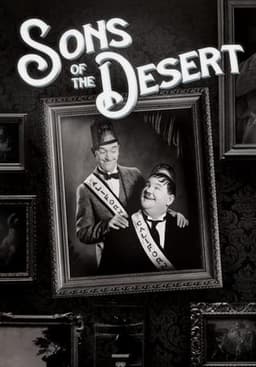
Sons of the Desert
(1933)Two hapless husbands ditch their wives to party at a lodge convention, only to land in hot water when their sneaky plan backfires.
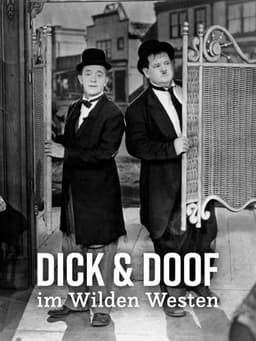
Way Out West
(1937)Arriving in the cow town of Brushwood Gulch, our heroes attempt to deliver the deed to a gold mine, as it was bequeathed to a deceased prospector’s daughter. A larcenous saloon keeper (James Finlayson) diverts them instead to his wife, a brassy saloon chirp who enacts the role of grieving daughter. Once this duplicity is exposed, the two tender heels must retrieve the deed and rescue the rightful heiress. Unadulterated Laurel & Hardy fun, spiced with surrealistic gags and sparkling musical interludes, including an Oscar®-nominated score by Marvin Hatley. The review in New Yorker magazine declared the picture to be “leisurely in the best sense; you adjust to a different rhythm and come out feeling relaxed as if you’d had a vacation.

The Golden Age of Comedy
(1957)The most memorable comedic moments from Hollywood's silent era featuring stars like Laurel and Hardy, Harry Langdon, Will Rogers, and Ben Turpin.